
Metagame
Popular competitive archetypes in Universes Contained.
Below are some examples of popular competitive archetypes in the Universes Contained format. Many of them you will recognize as top decks of yesteryear in formats like Modern, old Standard powerhouses, and current Pioneer decks (as Pioneer is the closest official format to Universes Contained in terms of card pool), but there are also new and unique archetypes in the mix by virtue of the reduced power level and some of the format-specific legality rules (e.g., cards from Jumpstart or normally Legacy-only dual lands being allowed).
Mono-Red Aggro
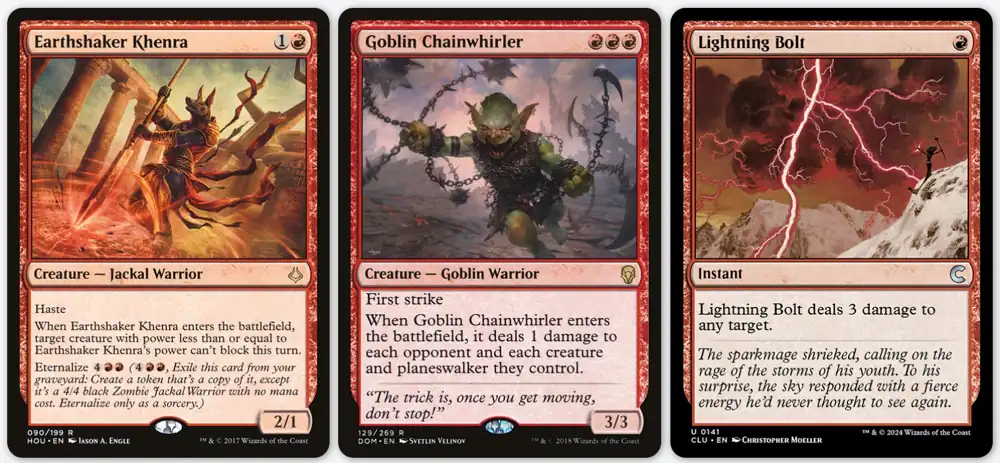
The bane of many Magic: Arena formats since the digital game’s release, mono-red aggro is as strong here as it is anywhere, bolstered by the availability of “Lightning Bolt” in what is otherwise a low-power environment.
Even with many of the strongest cards in the archetype banned, you have a plethora of options to pick from, from “Boltwave” and “Skullcrack” on the burn spell side, to “Bomat Courier” and “Eidolon of the Great Revel” on the creature side (not to mention cards like “Vexing Devil” which are a little of both). This archetype ends games very quickly unless answered immediately.
Mono-Black Control
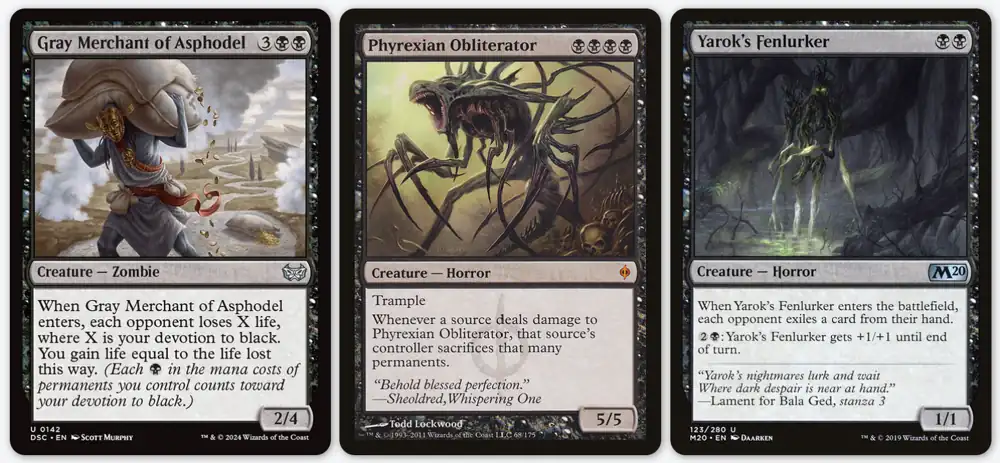
Look, there’s no way to sugarcoat it—at this power level, a lot of decks just straight-up lose to “Phyrexian Obliterator” (especially red and green decks that have no source of creature removal that isn’t damage-based, other than a handful of color pie outliers like “Aftershock” and “Beast Within”). That was true when New Phyrexia dropped and it remains true in Universes Contained to this day.
Black also has a bevy of fantastic support cards for a control shell to go along with it, including format all-stars “Duress” and “Requiting Hex”, as well as premier removal such as “Hagra Mauling” and “Infernal Grasp”. Notably, a lot of the strongest black cards (including “Phyrexian Obliterator” itself) have multiple black color pips in their costs (e.g., “Gatekeeper of Malakir”, “Gifted Aetherborn”, and “Dread Shade”), which means “Gary” (“Gray Merchant of Asphodel”) will often drain your opponents for a significant amount of life, easily enough to close out most games.
Azorius Control
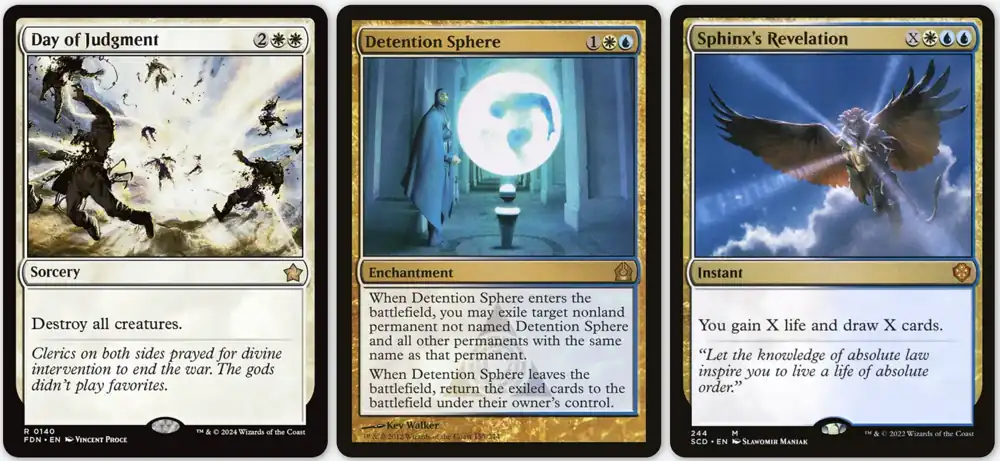
A good rule of thumb for Universes Contained metagaming is “if a deck is competitive in Pioneer, and none of its essential components are banned, it will be very good in Universes Contained.” Despite some high-profile bans, including both the 3-mana and 5-mana Teferis and “No More Lies”, Azorius Control is an incredibly resilient archetype that, when faced with the loss of any particular component due to a ban or the format’s legality cutoff, has no problem simply slotting in the next best alternative and chugging onward.
The availability of powerhouse finishers (including a variety of powerful planeswalkers such as “The Wandering Emperor” and “Elspeth, Sun's Champion”), plentiful 4-mana and 5-mana boardwipes, and stellar white-based removal for any (nonland) permanent type has made this archetype a constant threat over the years.
Reanimator
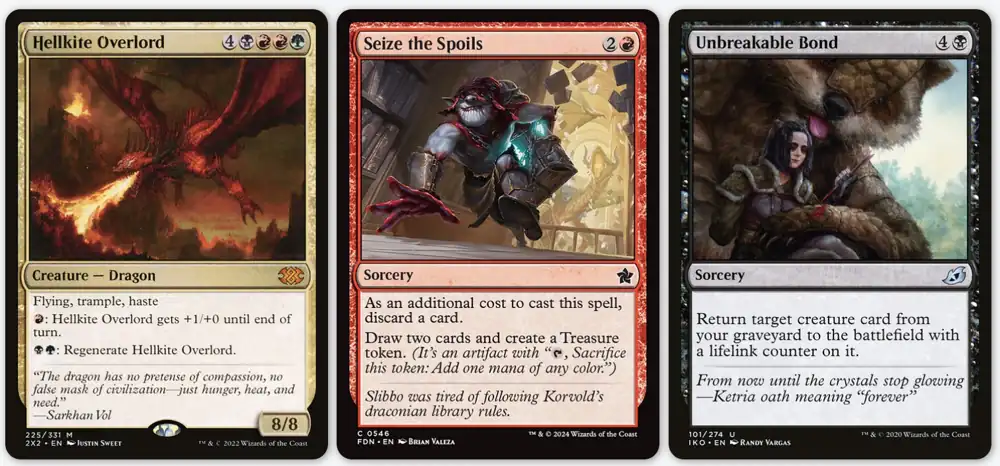
Reanimator is a flexible archetype that can field massive threats quickly. A turn 1 “Llanowar Elves” followed by a turn 2 “Invasion of Ergamon” allows you to cast any 5-mana reanimate effect on turn 3 on your choice of target. The combination of something like “Hellkite Overlord” or “Dragonlord Atarka” with the lifelink of “Unbreakable Bond” is backbreaking for most opponents, especially aggro-oriented strategies. And there are a plethora of powerful 5-mana reanimates in the format, all of which can be built around in different ways—maybe you want to double ETBs with “Coiling Rebirth” or exploit counter synergies with “Vat Emergence”, for example.
It's also possible to build an artifact-centric build using “Refurbish” and “Tune Up”, or a build focused around powerful cards like “Progenitus” or “Blightsteel Colossus” with shuffle-in effects using instant-speed reanimates like “Live or Die”. Reanimator and decks like it are strong enough that many decks will try to mainboard at least some graveyard exile effects (such as “Heritage Reclamation” or “Rakdos Charm”).
Affinity
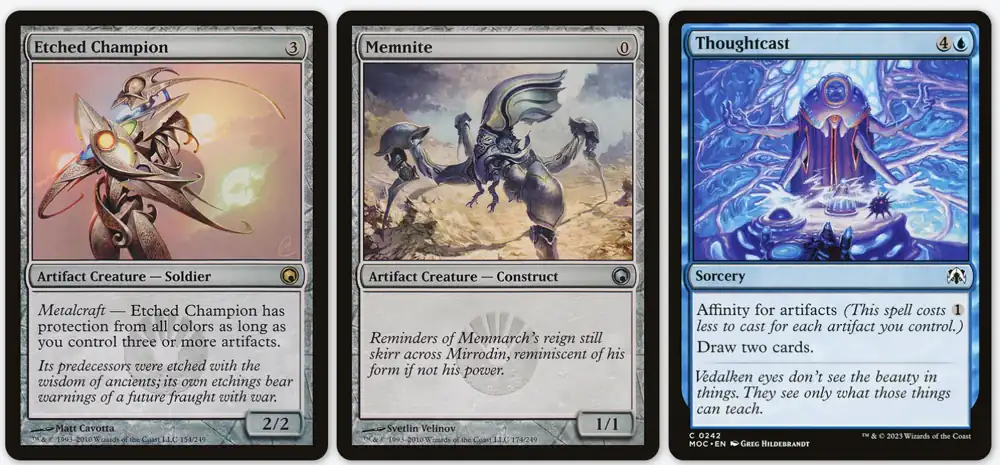
The availability of the Jumpstart sets in the format means that otherwise pre-cutoff affinity powerhouses “Myr Enforcer” and “Thoughtcast” are both legal in the format, and the “dual lands” rule means that all 10 indestructible dual lands from Modern Horizons 2 are legal as well. These cards, together with cards from Scars of Mirrodin block and the newer affinity cards from Aetherdrift, form a powerful and threatening core—and one that can be built in countless different ways and in virtually any combination of colors.
Affinity packages offer one of the few ways to ramp on turn 1 without green (using “Springleaf Drum” and a zero-drop artifact like “Ornithopter”), have access to powerful omnilands like “Spire of Industry”, and can either “go-wide” (with things like “Steel Overseer” and “Signal Pest”) or “go-tall” (with things like “Master of Etherium” and “Filigree Attendant”), and sometimes even both in the same deck. Aside from the obvious blue-based variants, red (thanks to “Galvanic Blast”) and black (thanks to “Demonic Junker”) are both notable options for affinity.
Eldrazi
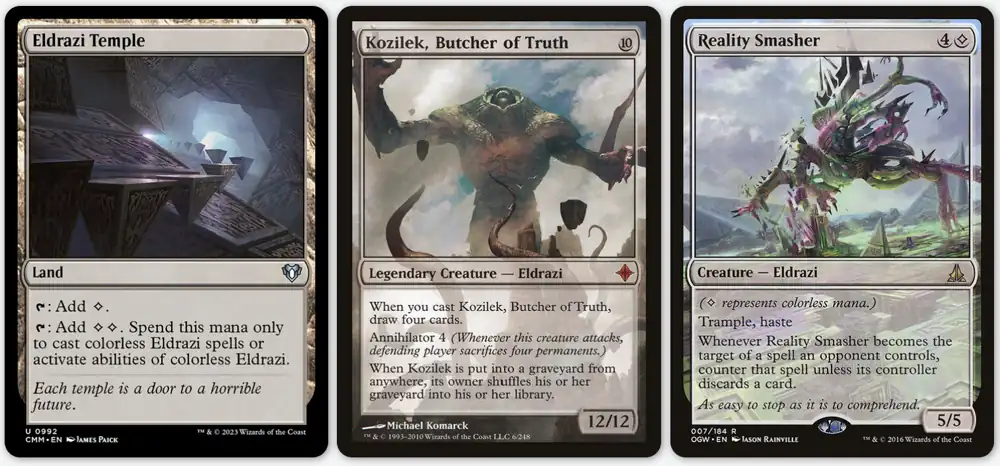
“Eldrazi Temple” is the only generically available 2-mana land in the format that doesn’t have a downside (beyond being type-restricted), and the availability of multiple colorless means to search for it (like “Planar Atlas” and “Inscribed Tablet”) means you will often have it when you need it. Like Affinity or Reanimator, a big advantage of Eldrazi lies in the archetype’s flexibility—you can go all-in on the big boys and ramp out an Eldrazi Titan, or go for more of a midrange control shell, or pick a specific powerful card (such as “Eldrazi Displacer”, “Endbringer”, or “Elder Deep-Fiend”) and build around it.
In addition to the obvious mono-colorless variants, Eldrazi-based strategies can also mix in green for stellar ramp (such as “Overgrown Battlements” or “Overgrowth”), red for repeatable boardwipes with “Kozilek’s Return”, or blue for a wishboard-style gameplan based around “Coax from the Blind Eternities”—all of which have their own strengths and weaknesses, but none of which should be underestimated.
Tron
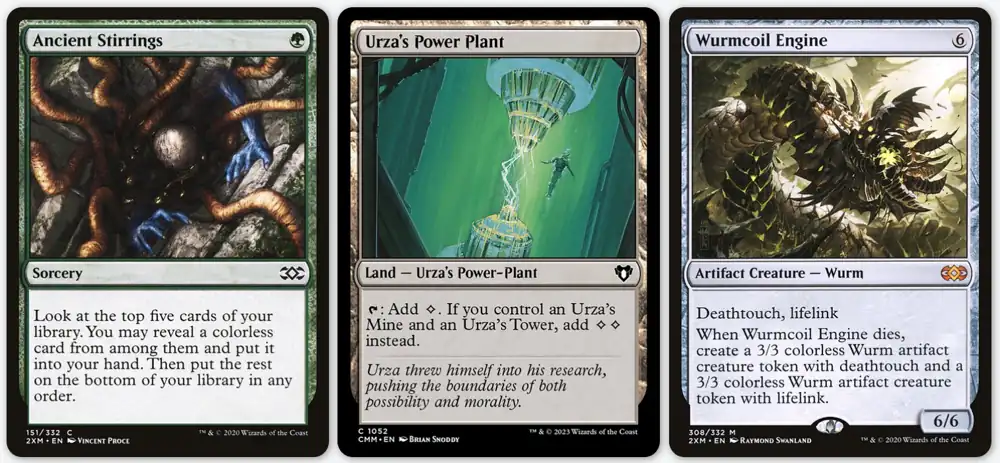
Of course, if we’re going to talk about 2-mana lands, we’d be remiss not to discuss the original colorless powerhouse—Tron! Legal in the format thanks to Jumpstart 2022 introducing all 3 of the original “Urzatron” lands, green-based Tron with [[Sylvan Scrying]] and [[Ancient Stirrings]] is in fact able to go online as early as turn 3, as in Modern and older formats.
Universes Contained doesn’t have all of the top-end Tron threats of higher-power formats (both “Ugin, the Spirit Dragon” and “Sire of Seven Deaths” are banned, for example), but Tron classics “Wurmcoil Engine” and “Karn Liberated”, as well as new-age threats like “Extinguisher Battleship” and “Phyrexian Fleshgorger”, ensure that this archetype is a force to be reckoned with.
Conventional Ramp
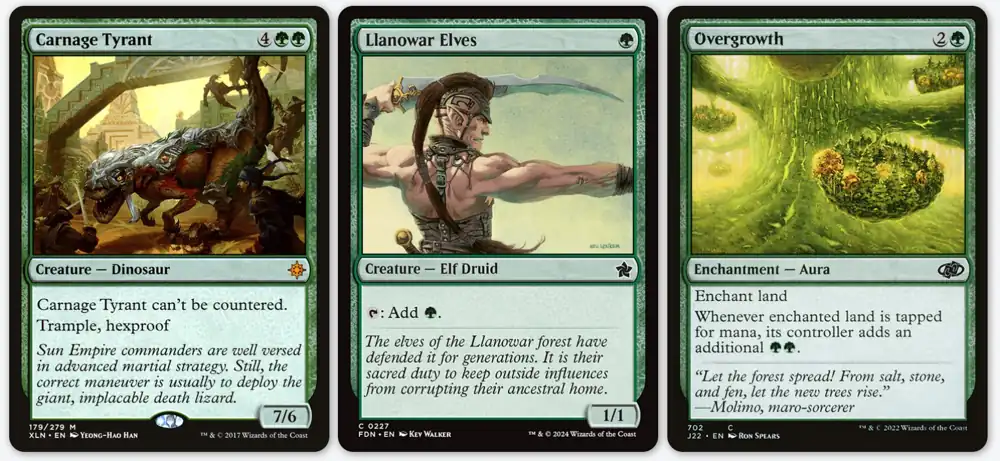
Tron represents a unique way to quickly ramp to a point where you can hardcast high drops… but it’s actually possible, with an ideal line, to get there through conventional means as well. A turn 1 “Llanowar Elves” (or “Arboreal Grazer”) followed by a turn 2 “Overgrowth” (or equivalent, like “Somberwald Sage”) allows you to hardcast a six-drop by turn 3, and there are plenty of back-breaking six-drops that can help stabilize and take control of the game—the original “Titans” and “Gearhulks”, along with one-off cards like “Massacre Wurm”, being fairly straightforward examples.
Definitionally, these decks are base green, but it is relatively easy to mix in a second color, and if you are willing to settle for five-drops instead of six-drops, you can use “Cultivate” in the three-drop slot and fairly easily cast five-drops of any color combination.
Death and Taxes
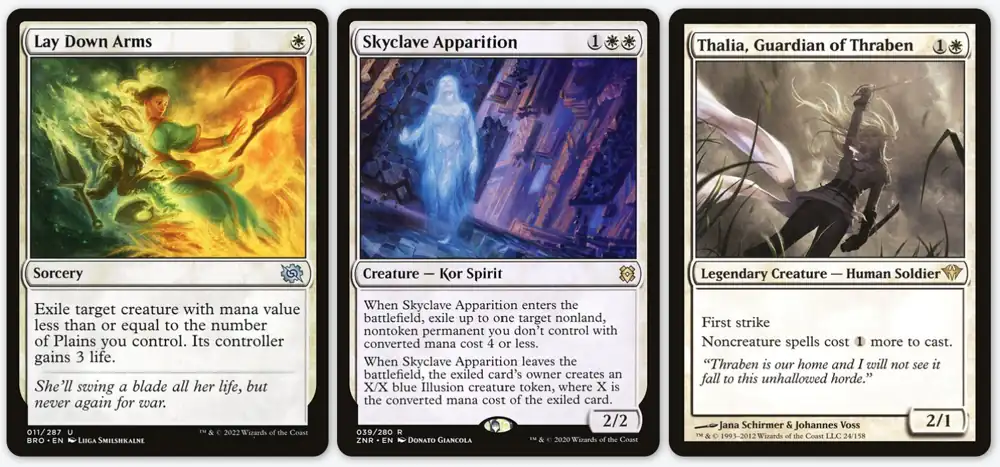
White-based “hatebears” is a powerful archetype in most formats, and Universes Contained is no exception—between “Containment Priest”, “Hushbringer”, and “Archon of Emeria”, you can hose just about any common strategy while still playing your threats on curve. There are plenty of three-drop “Banishing Light” effects with legs that get around Thalia’s tax (such as “Werefox Bodyguard” and “Brutal Cathar”), and “Phyrexian Vindicator” makes for a powerful finisher in the mono-white build.
On the other hand, mixing in a second color can bring new hatebears to the table—“Lavinia, Azorius Renegade” shuts things like “Dreadhorde Arcanist” and “Thoughtcast” down cold, “Scavening Ooze” is great against any graveyard-based strategies, and “Harsh Mentor” punishes manlands, sacrifice outlets, and Equipment like nobody’s business.
Domain Zoo
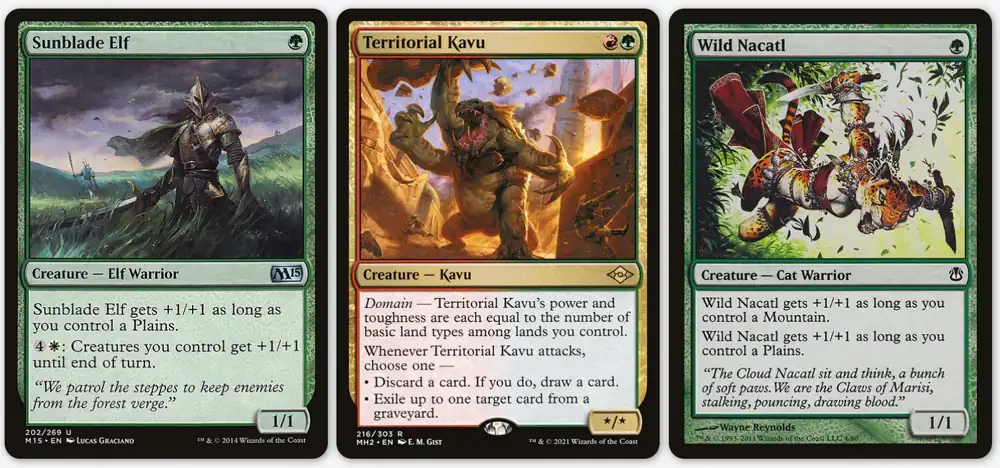
The lack of shocklands and Triomes in Universes Contained is a big hurdle to competitive viability for the archetype, but using a mix of untapped basic Forests and off-color taplands (like “Radiant Summit”), sometimes with things like “Arboreal Grazer” and “Farseek” to get more lands on board faster, it is still possible to have full domain online by turn 3, at which point you have up to 8 total one-mana +5/+5 pump spells (“Might of Alara” and “Gaea’s Might”) and numerous high-power low-drops (including “Loam Lion” and “Nishoba Brawer”) to serve as haymakers at your disposal.
Domain decks are usually “base Naya” (like traditional Modern Zoo decks), and will often run classic Zoo cards like “Qasali Pridemage” and “Lightning Helix” for that reason, in addition to the domain package. Swamps and Islands are essentially included only to increase your maximum domain count.
Hollow One
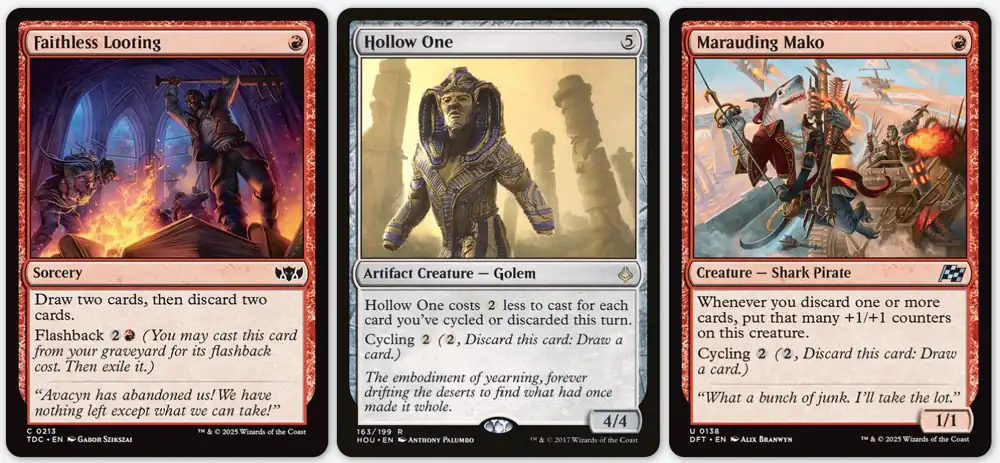
With “Faithless Looting” unrestricted and “Ash Barrens” legal by virtue of Foundations Jumpstart, this archetype has a huge boost to its power compared to what’s available in Pioneer (the most comparable “official” format otherwise). It’s often possible to get all three “Monument to Endurance” effects off in a single turn, on multiple back-to-back turns, which can end games fast regardless of matchup.
The format has access to a number of powerful from-graveyard effects from over the years, such as eternalize, jump-start, aftermath, and harmonize, so there are often profitable ways to use the cards you’re pitching (even outside of the obvious synergies with things like madness and “Flameblade Adept”). The various loot and rummage effects which power the engine also ensure you see a high percentage of your total deck every game, allowing “silver bullet”-type cards to be more impactful (particularly if you aren’t sideboarding).
Death’s Shadow
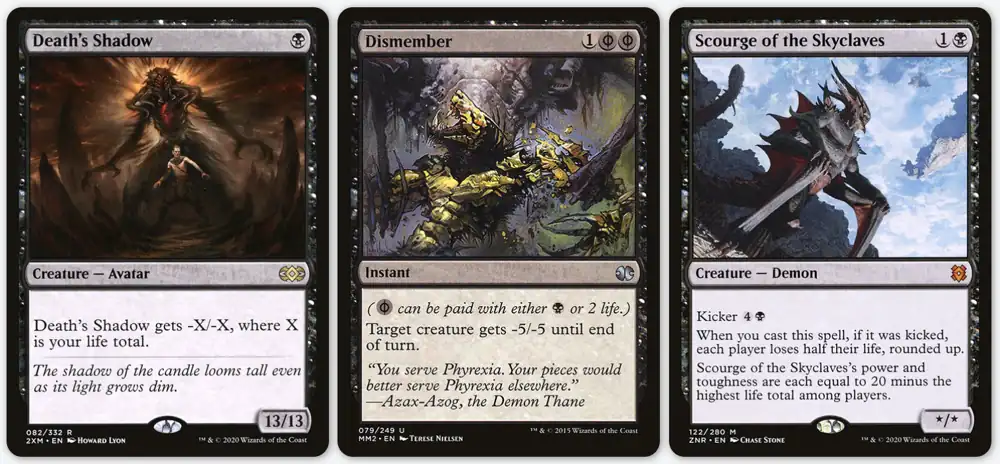
Universes Contained has 4 legal “Death’s Shadow”-esque cards (the original “Death’s Shadow”, “Scourge of the Skyclaves”, “Shadow of Mortality”, and “The Last Ride”), and plenty of powerful ways to lower your own life for upside, such as “Ulcerate”, “Sign in Blood”, and “Dark Confidant”, as well as various different kinds of painlands, so it is usually pretty easy to bring yourself down to a low enough life total that one of these threats can close out a game in a swing or two.
It doesn’t take much added to the base package—maybe a “Leyline Axe” for a reliable one-shot, or mixing in a second color for a source of instant speed double strike and/or trample—to be able to deliver lethal damage in a single, unexpected attack, and snatch victory from the jaws of defeat.
Hardened Scales
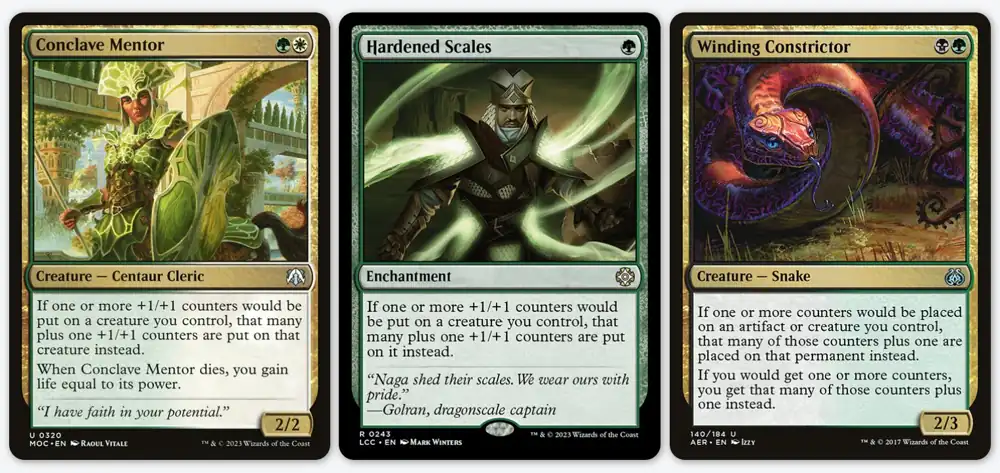
Green-based +1/+1 counter strategies, which often skew Golgari for “Winding Constrictor” or Selesnya for “Conclave Mentor” (and not all of them even run “Hardened Scales”), are very strong in the Universes Contained format, primarily because they have been well-supported by Wizards of the Coast over the years and virtually none of their pieces are restricted in any way.
“Dusk Legion Duelist” plus cheap counter sources like “Honor” and “Homestead Courage” can draw lots of cards for very little mana, and dependable, versatile threats like “Rishkar, Peema Renegade” and “Scavenging Ooze” can let you branch out into ramp or control strategies without much infrastructure. It is not uncommon (particularly in Golgari-focused builds) to mix in an energy package (and exploit cards like “Glint-Sleeve Siphoner” and “Aether Hub”), or proliferate effects, since many counter-related effects work with multiple counter types.
Favorable Winds
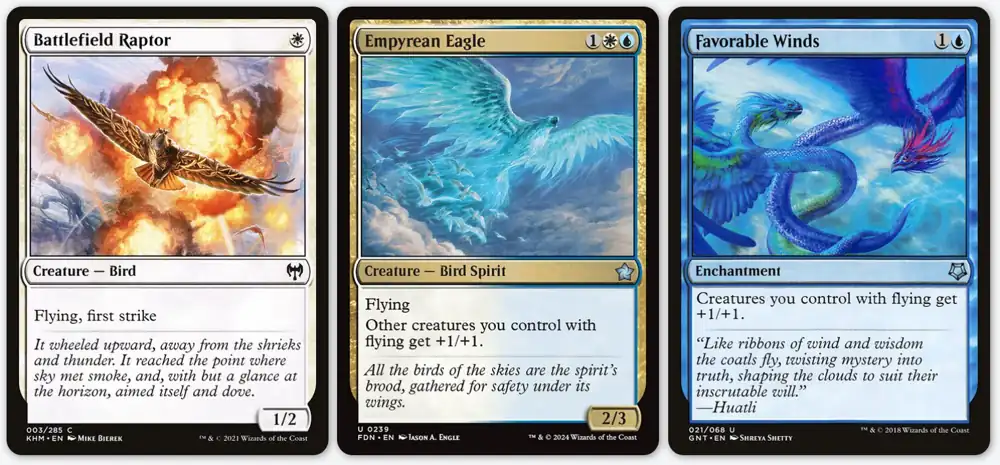
Almost every color pair and mono-color is capable of fielding an effective aggro deck in the Universes Contained format… except that blue will often fall short. Azorius “flying matters” is one archetype where that is most certainly not the case, however.
There are numerous powerful one-drop flyers, several of which have multiple upsides besides, like “Healer’s Hawk” and “Spectral Sailor”, and two “lord” effects (for 8 total deck slots) is enough to power them into the competitive metagame.
Weapons Manufacturing
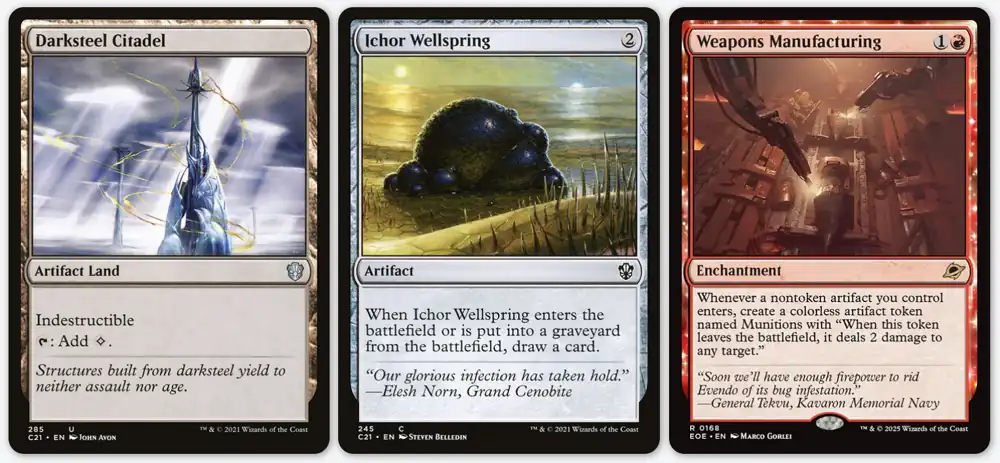
Edge of Eternities fomented a new breed of combo deck (though admittedly versions of it existed before with things like “Defiant Salvager” and “Makeshift Munitions”) based around spamming cheap artifacts to make Munitions, then blowing them all up. “Ravenous Intruder” (for all practical purposes, just an “Atog”) and “Brotherhood’s End” can clear your board fast, and there are many one-mana cantripping artifacts like “Experimental Synthesizer” and “Chromatic Star” to serve as interchangeable workhorses in the deck. Artifact lands, including the 10 indestructible dual lands from Modern Horizons 2, and zero-drop artifacts like “Tormod’s Crypt” are also notable.
Because “Weapons Manufacturing” is red, these decks are often mono-red, but mixing in blue for “Cryogen Relic” or black for “Blood Fountain” are both defensible.
Omen Hawker
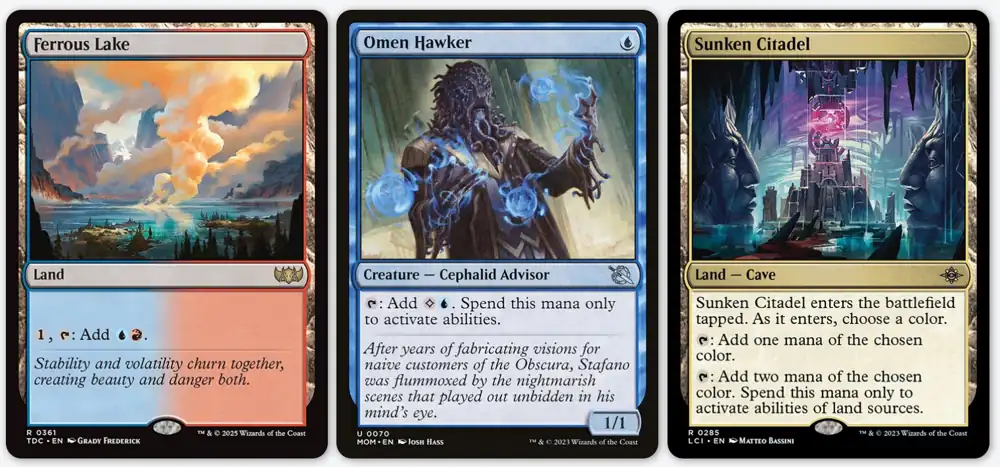
Unlike in Pioneer, in Universes Contained, all 10 Lorwyn block filterlands and all 10 Odyssey block filterlands are legal by virtue of the “dual lands” rule, which allows you to easily launder the mana from an “Omen Hawker” or “Sunken Citadel” into regular mana. This allows nongreen decks to match green on ramp speed pound-for-pound (with 5 mana on turn 3 assuming an untapped blue source, 2 filterlands, and one “Omen Hawker”).
Once your mana is filtered, it can be used to cast… well.. anything! But, of course, there are also powerful activated abilities that can capitalize on your unfiltered extra mana, such as “Harvester of Misery” and “Trumpeting Carnosaur” for Hawker and the powerful “manlands” like “Celestial Colonnade” and “Creeping Tar Pit” for Citadel.
Bogles
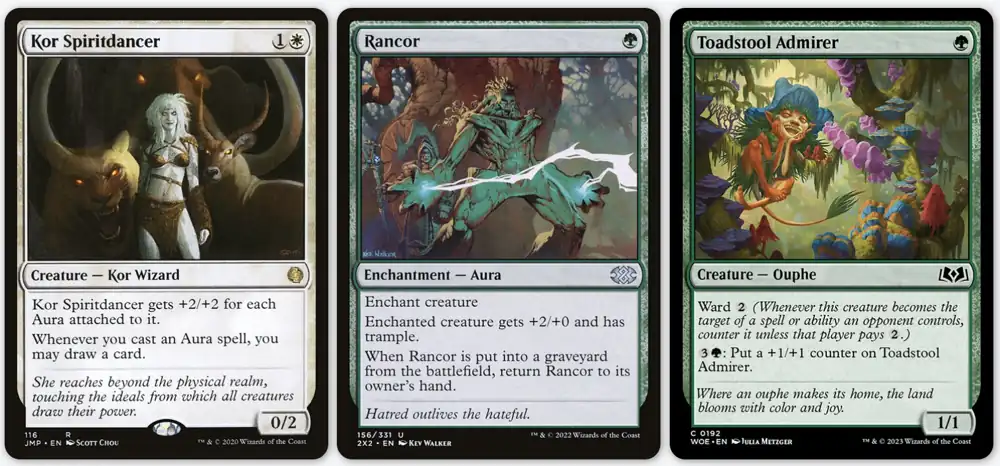
Once-powerful Modern decks have a high likelihood of being competitive in Universes Contained as long as the essential pieces are intact. The fact that actual “Slippery Bogle”, the deck’s namesake, is banned has not stopped this classic archetype from being a tournament-caliber threat—“backup” Bogles, like “Toadstool Admirer” and “Invisible Stalker”, can get the job done well enough, and “Kor Spiritdancer” can ensure you keep a fistful of cards in hand in case your Bogle gets edicted or something along the way.
The printing of “Shardmage’s Rescue” was a big boost to this archetype, as it (along with “Hyena Umbra”) allows ward-based Bogles to more reliably act as true Bogles, but the fact that so many of the best cheap stat-buff Auras happen to be available in the card pool (e.g., “Ethereal Armor”, “Audacity”, and “Staggering Insight”) is the true source of its staying power.
Izzet Spellslinger
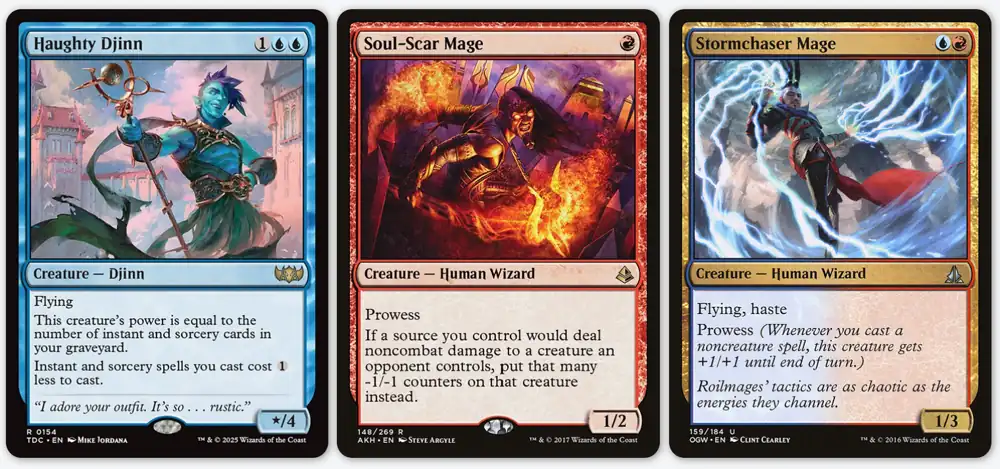
Universes Contained has “Ponder”, “Preordain”, “Lightning Bolt”, and “Faithless Looting” all unrestricted, and all four are some of the strongest cards in the format. A deck that can profitably play all of them, with upside for chaining multiple of them together, has an inherent competitive advantage over those that can’t.
There are countless options to choose for your payoff cards, depending on the specific type of sub-strategy you plan to deploy—“Stormcatch Mentor”, “Crackling Drake”, “Delver of Secrets”, “Dreadhorde Arcanist”, and so on—and the same is true for your actual spells (“Slick Sequence”, “Consider”, and “Torch the Tower” are all strong options), making this archetype both versatile and powerful.
Boros Equip
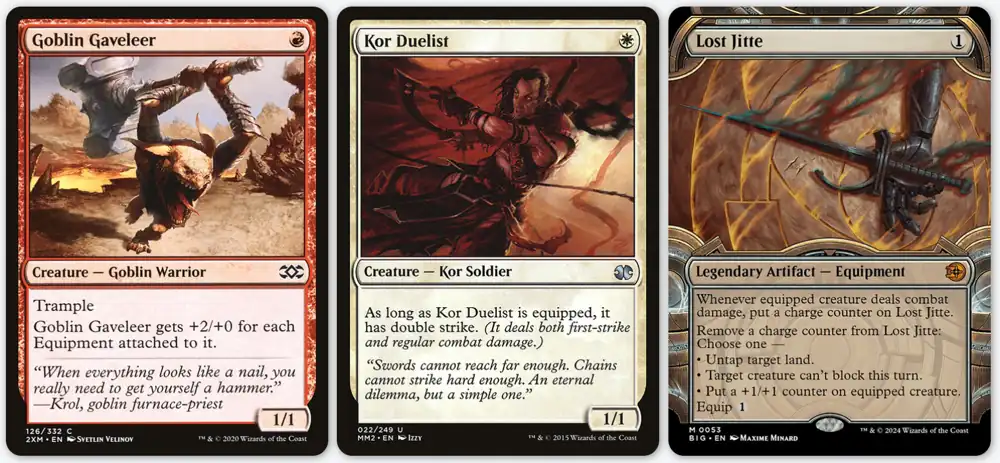
“Kor Duelist” is the only 1-mana doublestriker that can be live as early as turn 2 (thanks to powerful low-drop Equipment like “Eater of Virtue” and “Dire Flail”), and if you swing in on turn 2 with snap-on Equipment like “Dueling Rapier” and “Mirran Banesplitter”, can potentially dish out 10 damage before your opponent has even played a second land! Pair him with other efficient Equipment-based threats, like “Kitesail Apprentice” and “Goblin Gaveleer”, and you have a deck that can hit harder and faster than even mono-red aggro (assuming all goes according to plan).
More stable (albeit slower) variants based around cards like “Sigarda's Aid” can also be very powerful, and notably almost any 1-drop creature paired with “Lost Jitte” can allow you to start untapping lands as early as turn 2—which is functionally turn 1 ramp that doesn’t require green, even without any other tricks, but when paired with lands like “Lotus Field” and “Arid Archway”, can actually ramp you up to as much as 8 mana by turn 3 without requiring green, which is otherwise virtually unheard of in this format.
Energy
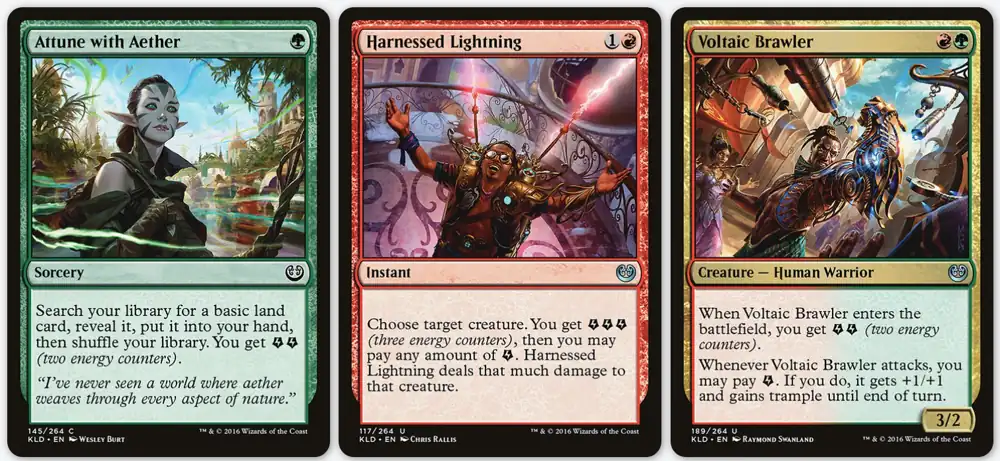
There are no energy-related cards in the format which are restricted in any way, and the format is, in general, lower-power than even Standard. Accordingly, good old fashioned Kaladesh block energy, often Gruul or sometimes Temur, but plausible in almost any color pairing, is as strong as it’s ever been.
This archetype almost never gets new cards it can make much use of (due to the “parasitic” nature of energy as a mechanic), but simply the classics like “Rogue Refiner” and “Bristling Hydra”, are usually strong enough to get the job done without any outside help (and often powerful generic staples like “Lightning Bolt” and “Snakeskin Veil” feel right at home alongside the energy suite).
Mono-Green Bullrush
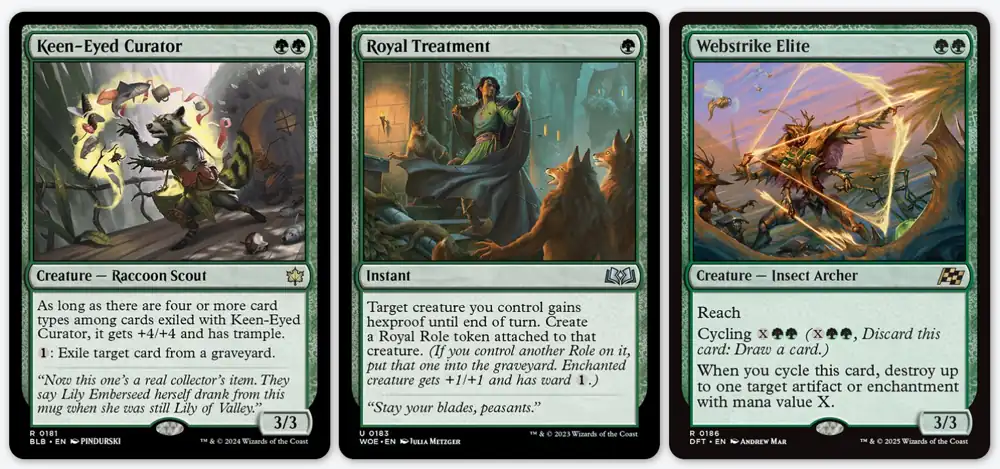
The Pioneer era of card design has introduced a number of powerful, efficiently-statted lower-drop beaters in monogreen, such as “Scrapshooter”, “Surrak, Elusive Hunter”, and “Ascendant Packleader”, that—when backed by just a handful of 1-drop protection spells and a handful of efficient “fight” or “punch” spells—can easily run away with a game. This archetype plays like an aggro deck but has the endurance and sturdiness of a midrange deck, which gives it game against the admittedly faster red-based aggro decks in the format. In particular, the fact that many of its threats fall just out of “Lightning Bolt” range means that offensive, fast green-based decks can often outmuscle red-based ones.
(And, of course, nothing is stopping you from having the best of both worlds by mixing the two archetypes together, which is made viable by cards like “Grumgully, the Generous” and “Zhur-Taa Goblin”.)
Backbone
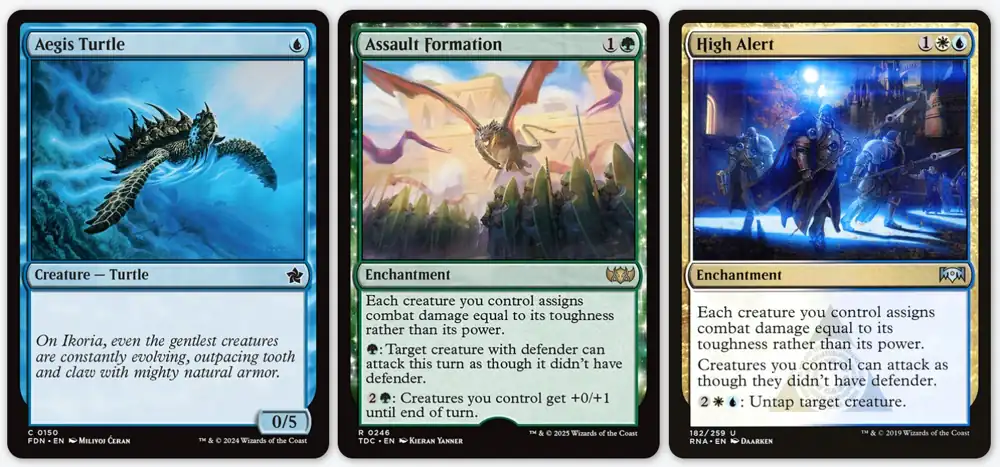
Thanks to two powerful and efficiently costed ‘anthems’ that essentially turn high-toughness creatures into high-power creatures for relatively cheap, “high toughness” aggro strategies are very powerful in the Universes Contained format. There are more than enough 0/4s for one (and one 0/5 for one) to fill out a full deck, along with multiple pump spells that—with your backbone enchantment live—have an obscene rate (like “Shape the Sands” and “Tower Defense”).
The drawback of this deck is that it is essentially toothless if you can’t land a source of backbone (or if your opponent blows it up), but thankfully the naturally high toughnesses do allow you to wait around a bit to draw another for longer than most decks can. This deck, when not disrupted, is shockingly fast—a turn 1 “Aegis Turtle” and “Ornithopter”, followed by a turn 2 “Assault Formation”, swing for 7 on turn 2 and lethal on turn 3 as long as you have any pump spell!
Micro Reanimate
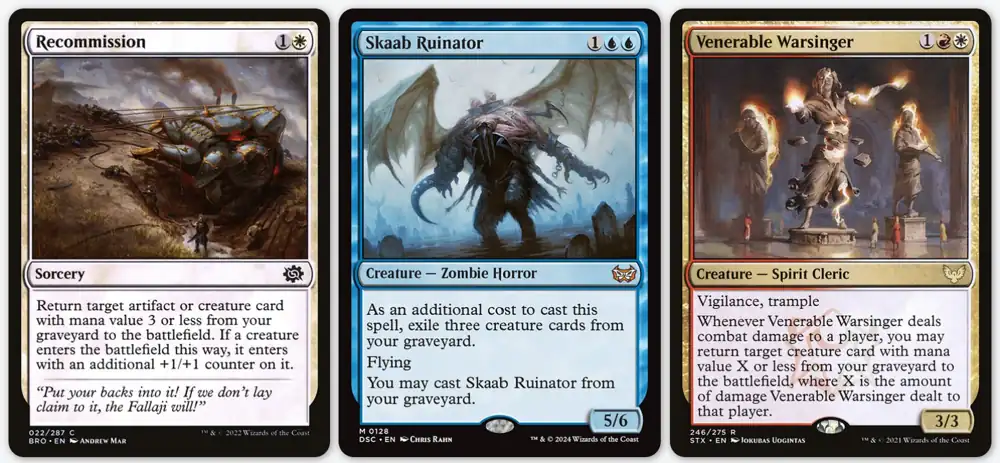
Since one-drop discard outlets are plentiful in Universes Contained (from the more streamlined “Haggle” and “Insolent Neonate” to the more powerful “Inquisition of Kozilek” and “Faithless Looting”), it is easily possible to cast a “Recommission” or a “Call a Surprise Witness” on turn 2 and bring out a surprisingly big and stupid creature. A turn 2 6/7 flyer is pretty tough to deal with a lot of the time. With “Helping Hand” you can do it off of just one land (assuming you’ve got an appropriate dual land like “Inspiring Vantage”).
The available pools of both “micro reanimate” spells and one-drop discard spells are relatively finite (though you have numerous options to choose from for both, more than enough to fill a deck), but as far as your three-drop creatures go, the sky’s the limit! Want a “Goblin Chainwhirler” to shut down aggro? How about “Knight of Autumn” for more flexibility? Or maybe you prefer “Cemetery Illuminator” or “Cemetery Prowler” to hose enemy graveyard-based decks? Pick your favorites and see how they do!
Mono-Blue Control
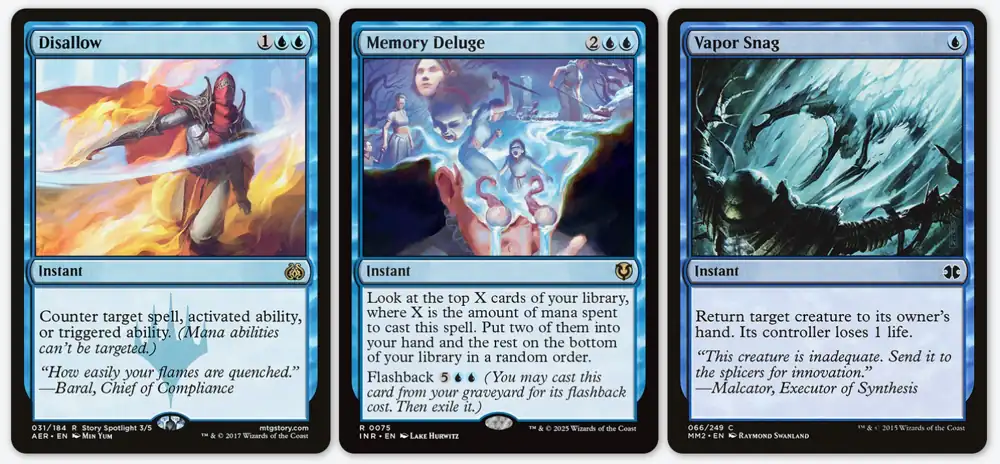
This is in some respects the oldest archetype known to Magic: just counterspell and bounce everything until you win! It’s an ancient and well-tested archetype, and it’s as strong as ever here. The dependability of having “perfect” mana (compared to something like Azorius control), with maybe a “Hall of the Storm Giants” or an “Inkmoth Nexus” as your only nonbasics, is tough to beat, and even the pure basic Islands version can really shine thanks to “Tempest Djinn”.
The format has best-in-class turn 1 disruption (in “Into the Flood Maw” and “Vapor Snag” for bounce, and “Spell Pierce” and “Spell Snare” for countermagic), all the 3 mana counterspells ever printed, and several powerful options for card draw you can fire off at the end of the opponent’s turn, like “Deduce”, “Coil and Catch”, and “Flow of Knowledge”. Your two-drop counterspell pool leaves a bit to be desired (with no “Counterspell” and “Mana Leak” banned), but usually “Jwari Disruption”, “Syncopate”, and various “Quench” variants will get the job done just fine.
Rakdos Aggro
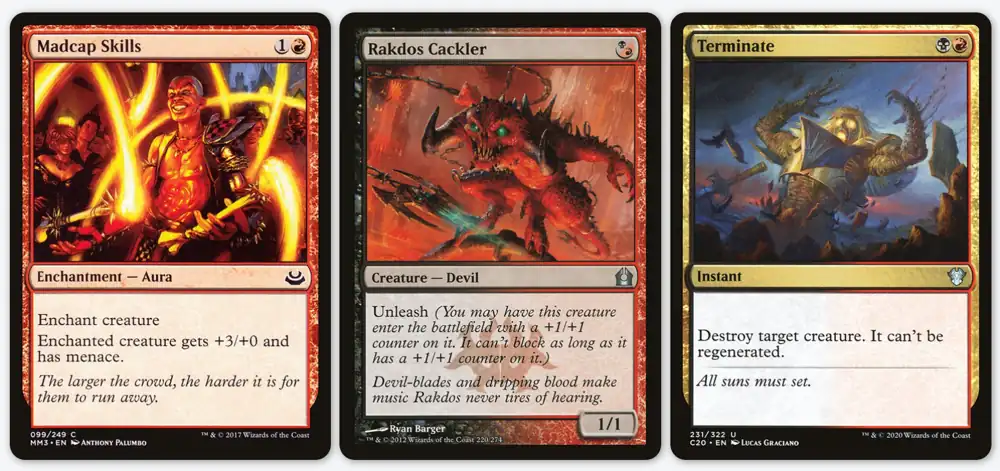
A variant of mono-red aggro that is able to capitalize on the unconditional creature removal of black to have game in matchups where “Lightning Bolt” doesn’t get the job done, Rakdos aggro hits hard and fast.
Powerful, cheap threats like “Dreadhorde Butcher” and premium removal like “Molten Collapse” set this color pair apart from the rest of the pack when it comes to offensive, low-to-the-ground strategies in the Universes Contained format.
Typal Strategies
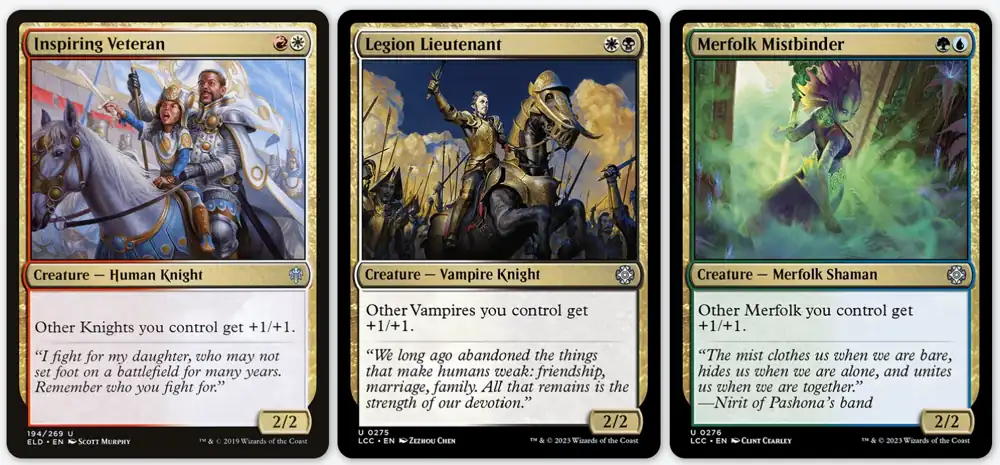
Several of the different powerful archetypes which are based on a single creature type—Merfolk, Goblins, Elves, Humans, Spirits, Elementals, and Zombies, for instance—could have their own standalone archetype description (the ones I just mentioned, for example, are all tournament-caliber archetypes in Universes Contained), but for simplicity, we chose to highlight them here as a group.
From a competitive standpoint, what makes these decks sing is that they usually have at least 2 very powerful, lower-drop creatures with “lord” abilities (that confer a stat bump and often some other benefit) that they can then pair with all of the best creatures of the chosen type that are legal in the format. Thanks to the availability of two type-neutral omnilands (“Unclaimed Territory” and “Secluded Courtyard”), typal strategies are often able to run 3 or more colors without consistency issues.
In addition to the obviously powerful and well-supported creature types mentioned above, Cats (“King of the Pride” is legal thanks to Foundations Jumpstart), Dogs, Rabbits, Soldiers, Warriors, Knights, Dragons, and Angels are all very strong in Universes Contained.